
ESP32 블루투스 모니터 예제 실시간 시리얼 모니터 인터페이스 튜토리얼
개요
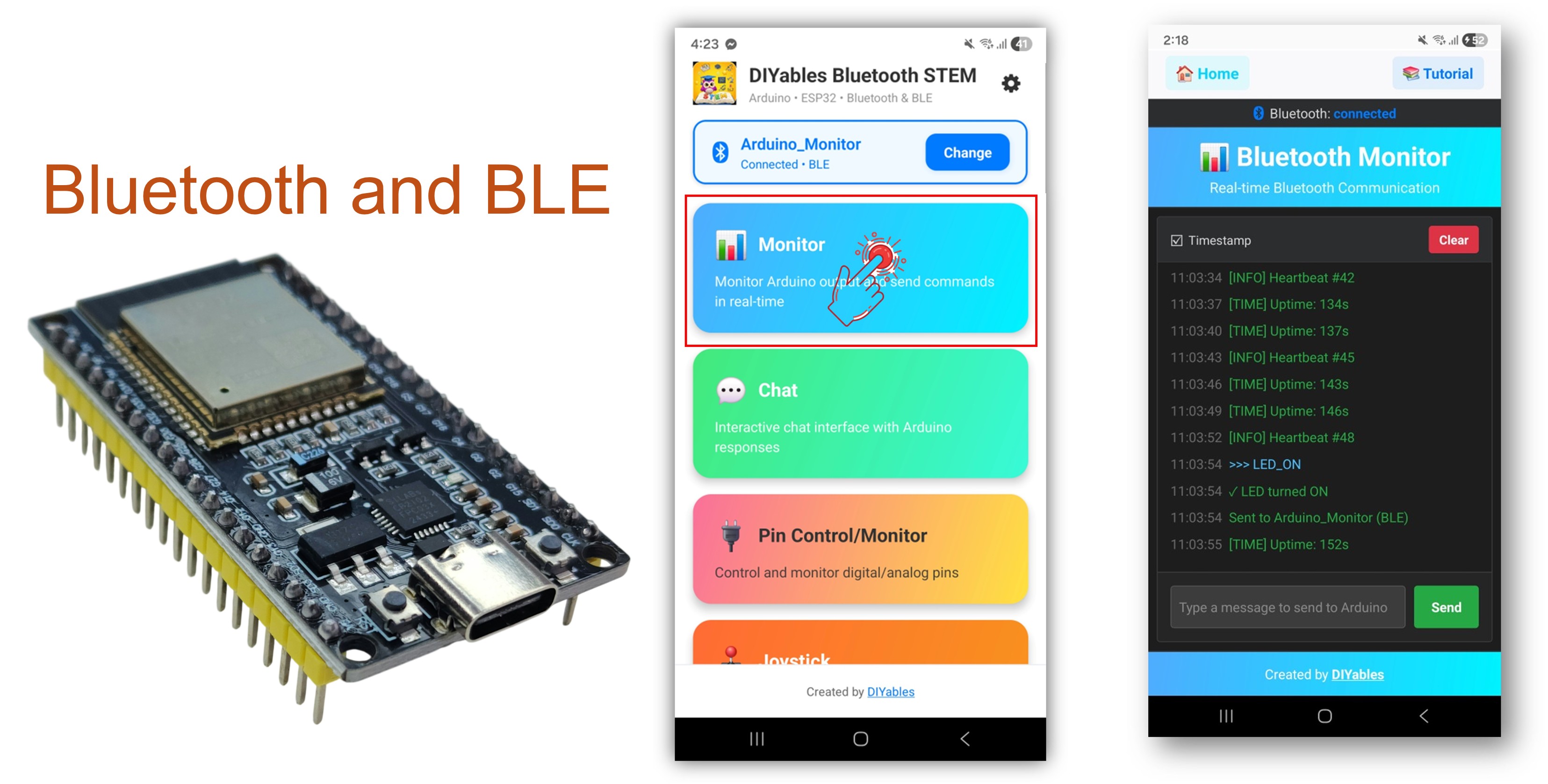
블루투스 모니터 예제는 DIYables Bluetooth STEM 앱을 통해 접근할 수 있는 무선 시리얼 모니터 인터페이스를 제공합니다. ESP32 보드용으로 설계되었으며 BLE(블루투스 저에너지)와 클래식 블루투스 연결을 모두 지원합니다. 실시간 상태 메시지를 앱으로 스트리밍하고, 텍스트 명령을 수신하여 처리하고, 시스템 정보를 표시하고, 프로젝트를 무선으로 디버깅하세요 — 무선 모니터링, 원격 디버깅, 시스템 상태 표시에 적합합니다.
이 예제는 두 가지 블루투스 모드를 지원합니다:
- ESP32 BLE (블루투스 저에너지): Android와 iOS 모두에서 작동
- ESP32 클래식 블루투스: Android에서만 작동. iOS는 클래식 블루투스를 지원하지 않습니다. iOS 지원이 필요한 경우 BLE를 사용하세요.
기능
- 실시간 스트리밍: 앱 디스플레이로 지속적인 상태 메시지 전송
- 명령 처리: 앱에서 텍스트 명령을 수신하여 처리
- 시스템 모니터링: 업타임, 여유 힙, CPU 정보 등 표시
- LED 제어: 빠른 테스트를 위한 내장 LED ON/OFF 명령
- 주기적 업데이트: 설정 가능한 간격으로 자동 하트비트 및 상태 메시지
- BLE & 클래식 블루투스: 프로젝트에 맞는 블루투스 모드 선택
- 크로스 플랫폼: BLE 모드는 Android와 iOS 모두에서 작동; 클래식 블루투스는 Android에서만 작동
- 저전력 옵션: BLE 모드는 클래식 블루투스보다 전력 소모가 적음
필요한 하드웨어
| 1 | × | 38-pin ESP32 ESP-WROOM-32 Dev Module - Narrow | 쿠팡 | 아마존 | |
| 1 | × | (또는) 38-pin ESP32 ESP-WROOM-32 Dev Module - Wide | 쿠팡 | 아마존 | |
| 1 | × | (또는) 30-pin ESP32 ESP-WROOM-32 Dev Module - Wide | 아마존 | |
| 1 | × | (또는) ESP32 Uno-form board | 아마존 | |
| 1 | × | (또는) ESP32 S3 Uno-form board | 아마존 | |
| 1 | × | USB 케이블 타입-A to 타입-C (USB-A PC용) | 쿠팡 | 아마존 | |
| 1 | × | USB 케이블 타입-C to 타입-C (USB-C PC용) | 아마존 | |
| 1 | × | 브레드보드 | 쿠팡 | 아마존 | |
| 1 | × | 점퍼케이블 | 쿠팡 | 아마존 | |
| 1 | × | (추천) ESP32용 스크루 터미널 확장 보드 | 쿠팡 | 아마존 | |
| 1 | × | (추천) Breakout Expansion Board for ESP32 | 쿠팡 | 아마존 | |
| 1 | × | (추천) ESP32용 전원 분배기 | 쿠팡 | 아마존 |
공개: 이 포스팅 에 제공된 일부 링크는 아마존 제휴 링크입니다. 이 포스팅은 쿠팡 파트너스 활동의 일환으로, 이에 따른 일정액의 수수료를 제공받습니다.
ESP32 코드
빠른 시작
다음 지침을 단계별로 따르세요:
- ESP32가 처음이라면 ESP32 - 소프트웨어 설치 튜토리얼을 참조하세요.
- USB 케이블로 ESP32 보드를 컴퓨터에 연결합니다.
- 컴퓨터에서 Arduino IDE를 실행합니다.
- 적절한 ESP32 보드와 COM 포트를 선택합니다.
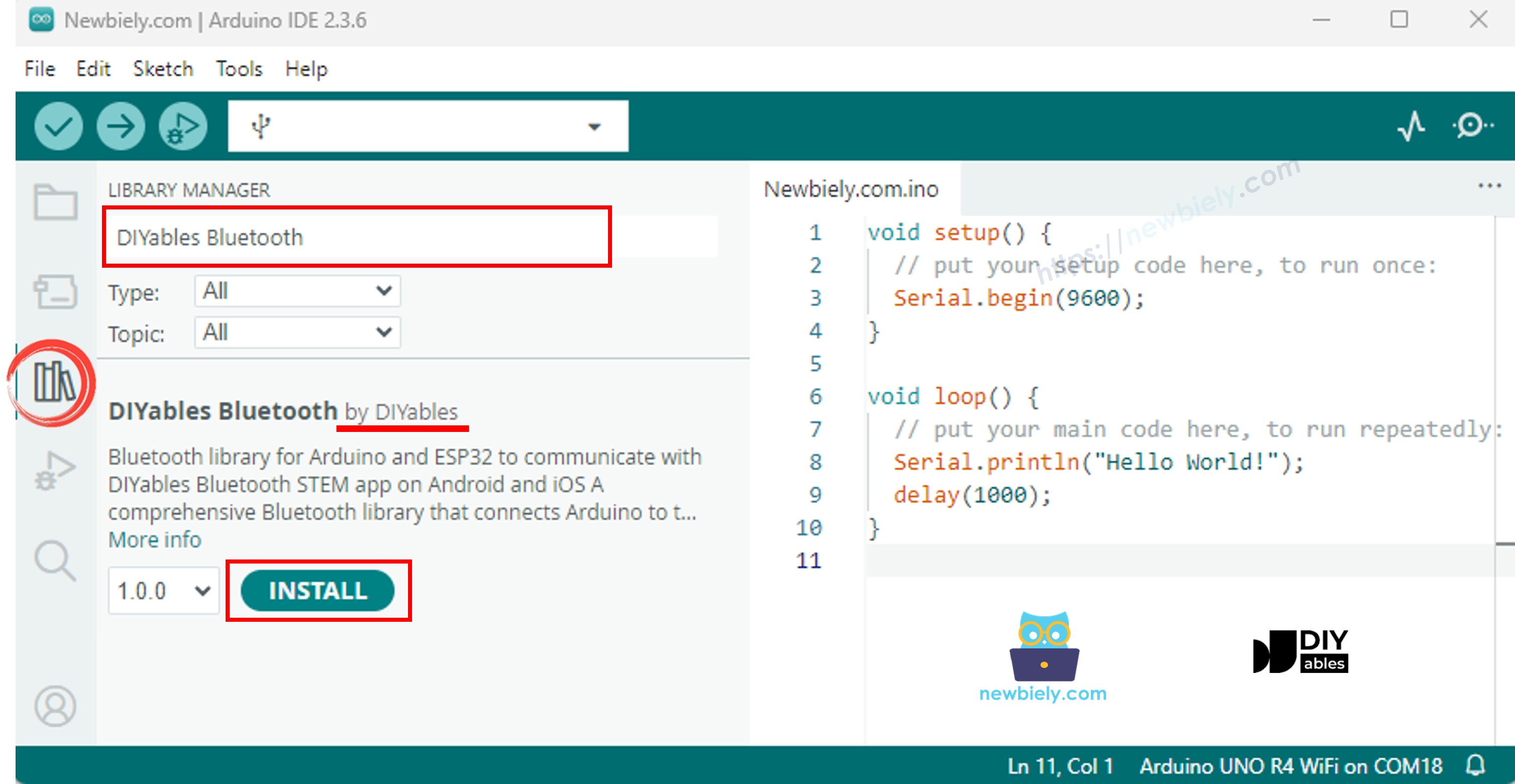
- Arduino IDE 왼쪽 바의 라이브러리 아이콘으로 이동합니다.
- "DIYables Bluetooth"를 검색한 다음 DIYables의 DIYables Bluetooth 라이브러리를 찾습니다.
- 설치 버튼을 클릭하여 라이브러리를 설치합니다.
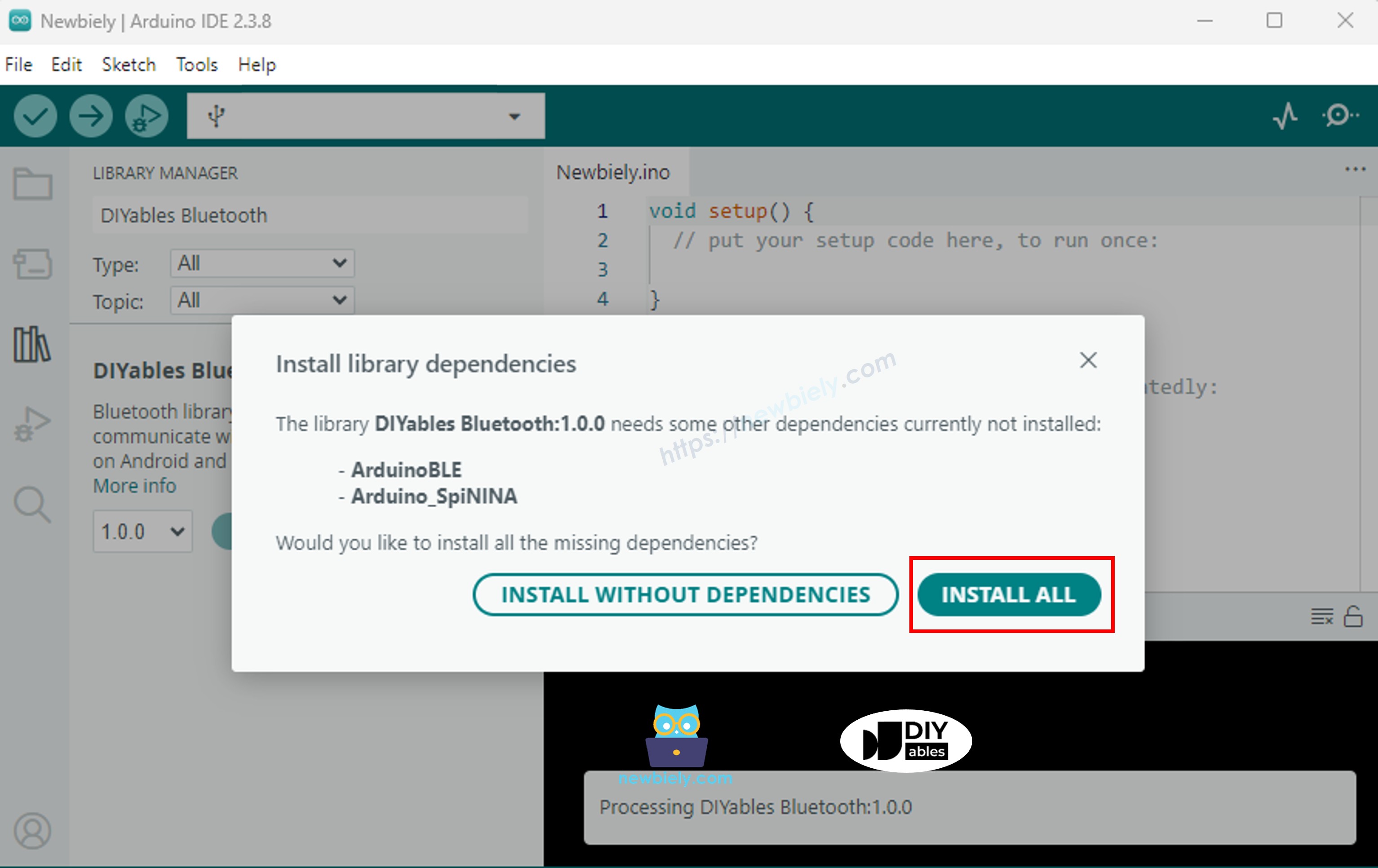
- 다른 라이브러리 종속성 설치 여부를 묻는 메시지가 표시됩니다.
- 모두 설치 버튼을 클릭하여 모든 라이브러리 종속성을 설치합니다.
필요에 따라 아래 두 가지 블루투스 모드 중 하나를 선택하세요:
ESP32 클래식 블루투스 코드 (Android의 앱에서만 작동)
참고: 클래식 블루투스는 iOS에서 지원되지 않습니다. iOS 지원이 필요한 경우 아래 BLE 코드를 사용하세요.
- Arduino IDE에서 파일 예제 DIYables Bluetooth Esp32Bluetooth_Monitor 예제로 이동하거나, 위의 코드를 복사하여 Arduino IDE 편집기에 붙여넣습니다.
/*
* DIYables Bluetooth Library - ESP32 Classic Bluetooth Monitor Example
* Works with DIYables Bluetooth STEM app on Android
* Note: Classic Bluetooth is NOT supported on iOS. Use BLE examples for iOS support.
*
* This example demonstrates the Bluetooth Monitor feature:
* - Send real-time status messages to the mobile app
* - Display system information and sensor readings
* - Receive and process commands from the app
* - Perfect for debugging and system monitoring
*
* Compatible Boards:
* - ESP32 (all variants with Classic Bluetooth)
* - ESP32-WROOM-32
* - ESP32-DevKitC
* - ESP32-WROVER
*
* Note: Select "Huge APP (3MB No OTA/1MB SPIFFS)" partition scheme
* in Arduino IDE: Tools > Partition Scheme
*
* Setup:
* 1. Upload the sketch to your ESP32
* 2. Open Serial Monitor (115200 baud) to see connection status
* 3. Use DIYables Bluetooth App to connect and view monitor output
*
* Tutorial: https://diyables.io/bluetooth-app
* Author: DIYables
*/
#include <DIYables_BluetoothServer.h>
#include <DIYables_BluetoothMonitor.h>
#include <platforms/DIYables_Esp32Bluetooth.h>
// Create Bluetooth instances
DIYables_Esp32Bluetooth bluetooth("ESP32_Monitor");
DIYables_BluetoothServer bluetoothServer(bluetooth);
// Create Monitor app instance
DIYables_BluetoothMonitor bluetoothMonitor;
// Variables for demo
unsigned long lastUpdate = 0;
const unsigned long UPDATE_INTERVAL = 3000; // Send update every 3 seconds
int messageCount = 0;
bool ledState = false;
// ESP32 built-in LED (may vary by board)
const int LED_PIN = 2;
void setup() {
Serial.begin(115200);
delay(1000);
Serial.println("DIYables Bluetooth - ESP32 Monitor Example");
// Initialize LED
pinMode(LED_PIN, OUTPUT);
digitalWrite(LED_PIN, LOW);
// Initialize Bluetooth server with platform-specific implementation
bluetoothServer.begin();
// Add monitor app to server
bluetoothServer.addApp(&bluetoothMonitor);
// Set up connection event callbacks
bluetoothServer.setOnConnected([]() {
Serial.println("Bluetooth connected!");
bluetoothMonitor.send("=== ESP32 Monitor Connected ===");
bluetoothMonitor.send("System Ready");
bluetoothMonitor.send("Type HELP for available commands");
bluetoothMonitor.send("");
});
bluetoothServer.setOnDisconnected([]() {
Serial.println("Bluetooth disconnected!");
});
// Set up message handler for incoming commands
bluetoothMonitor.onMonitorMessage([](const String& message) {
Serial.print("Received command: ");
Serial.println(message);
handleCommand(message);
});
Serial.println("Waiting for Bluetooth connection...");
}
void handleCommand(const String& cmd) {
if (cmd == "HELP") {
bluetoothMonitor.send("Available Commands:");
bluetoothMonitor.send(" LED_ON - Turn LED on");
bluetoothMonitor.send(" LED_OFF - Turn LED off");
bluetoothMonitor.send(" STATUS - Show system status");
bluetoothMonitor.send(" HEAP - Show memory info");
bluetoothMonitor.send(" CLEAR - Clear monitor (if supported)");
bluetoothMonitor.send(" HELP - Show this help");
}
else if (cmd == "LED_ON") {
digitalWrite(LED_PIN, HIGH);
ledState = true;
bluetoothMonitor.send("✓ LED turned ON");
}
else if (cmd == "LED_OFF") {
digitalWrite(LED_PIN, LOW);
ledState = false;
bluetoothMonitor.send("✓ LED turned OFF");
}
else if (cmd == "STATUS") {
showStatus();
}
else if (cmd == "HEAP") {
bluetoothMonitor.send("=== Memory Info ===");
bluetoothMonitor.send("Free Heap: " + String(ESP.getFreeHeap()) + " bytes");
bluetoothMonitor.send("Min Free Heap: " + String(ESP.getMinFreeHeap()) + " bytes");
bluetoothMonitor.send("Heap Size: " + String(ESP.getHeapSize()) + " bytes");
bluetoothMonitor.send("===================");
}
else if (cmd == "CLEAR") {
bluetoothMonitor.send("");
}
else {
bluetoothMonitor.send("✗ Unknown command: " + cmd);
bluetoothMonitor.send("Type HELP for available commands");
}
}
void showStatus() {
bluetoothMonitor.send("=== System Status ===");
// LED Status
bluetoothMonitor.send("LED State: " + String(ledState ? "ON" : "OFF"));
// Uptime
unsigned long uptime = millis() / 1000;
bluetoothMonitor.send("Uptime: " + String(uptime / 3600) + "h " + String((uptime % 3600) / 60) + "m " + String(uptime % 60) + "s");
// ESP32-specific info
bluetoothMonitor.send("Free Heap: " + String(ESP.getFreeHeap()) + " bytes");
bluetoothMonitor.send("CPU Freq: " + String(ESP.getCpuFreqMHz()) + " MHz");
bluetoothMonitor.send("Chip Model: " + String(ESP.getChipModel()));
// Messages sent
bluetoothMonitor.send("Messages Sent: " + String(messageCount));
bluetoothMonitor.send("====================");
}
void sendPeriodicUpdate() {
messageCount++;
// Example of different message types
if (messageCount % 3 == 0) {
bluetoothMonitor.send("[INFO] Heartbeat #" + String(messageCount));
}
else if (messageCount % 5 == 0) {
bluetoothMonitor.send("[HEAP] Free: " + String(ESP.getFreeHeap()) + " bytes");
}
else {
bluetoothMonitor.send("[TIME] Uptime: " + String(millis() / 1000) + "s");
}
Serial.print("Sent update #");
Serial.println(messageCount);
}
void loop() {
// Handle Bluetooth server communications
bluetoothServer.loop();
// Send periodic updates (only when connected)
if (bluetooth.isConnected() && millis() - lastUpdate >= UPDATE_INTERVAL) {
lastUpdate = millis();
sendPeriodicUpdate();
}
delay(10);
}
- Arduino IDE에서 업로드 버튼을 클릭하여 ESP32에 코드를 업로드합니다.
- 시리얼 모니터를 엽니다.
- 시리얼 모니터에서 결과를 확인합니다. 다음과 같이 표시됩니다:
8
Serial.println("Hello World!");
Message (Enter to send message to 'ESP32 Dev Module' on 'COM15')
New Line
9600 baud
DIYables Bluetooth - ESP32 Monitor Example
Waiting for Bluetooth connection...
ESP32 BLE 코드 (Android과 iOS 앱 모두에서 작동)
- Arduino IDE에서 파일 예제 DIYables Bluetooth Esp32BLE_Monitor 예제로 이동하거나, 위의 코드를 복사하여 Arduino IDE 편집기에 붙여넣습니다.
/*
* DIYables Bluetooth Library - ESP32 BLE Monitor Example
* Works with DIYables Bluetooth STEM app on Android and iOS
*
* This example demonstrates the Bluetooth Monitor feature:
* - Send real-time status messages to the mobile app
* - Display system information and sensor readings
* - Receive and process commands from the app
* - Perfect for debugging and system monitoring
*
* Compatible Boards:
* - ESP32-WROOM-32
* - ESP32-DevKitC
* - ESP32-WROVER
* - ESP32-S3
* - ESP32-C3
* - Any ESP32 board supporting BLE
*
* Note: Select "Huge APP (3MB No OTA/1MB SPIFFS)" partition scheme
* in Arduino IDE: Tools > Partition Scheme
*
* Setup:
* 1. Upload the sketch to your ESP32
* 2. Open Serial Monitor (115200 baud) to see connection status
* 3. Use DIYables Bluetooth App to connect and view monitor output
*
* Tutorial: https://diyables.io/bluetooth-app
* Author: DIYables
*/
#include <DIYables_BluetoothServer.h>
#include <DIYables_BluetoothMonitor.h>
#include <platforms/DIYables_Esp32BLE.h>
// BLE Configuration
const char* DEVICE_NAME = "ESP32BLE_Monitor";
const char* SERVICE_UUID = "19B10000-E8F2-537E-4F6C-D104768A1214";
const char* TX_UUID = "19B10001-E8F2-537E-4F6C-D104768A1214";
const char* RX_UUID = "19B10002-E8F2-537E-4F6C-D104768A1214";
// Create Bluetooth instances
DIYables_Esp32BLE bluetooth(DEVICE_NAME, SERVICE_UUID, TX_UUID, RX_UUID);
DIYables_BluetoothServer bluetoothServer(bluetooth);
// Create Monitor app instance
DIYables_BluetoothMonitor bluetoothMonitor;
// Variables for demo
unsigned long lastUpdate = 0;
const unsigned long UPDATE_INTERVAL = 3000;
int messageCount = 0;
bool ledState = false;
void setup() {
Serial.begin(115200);
delay(1000);
Serial.println("DIYables Bluetooth - ESP32 BLE Monitor Example");
// Initialize built-in LED
pinMode(2, OUTPUT); // ESP32 built-in LED is usually on GPIO 2
digitalWrite(2, LOW);
// Initialize Bluetooth server with platform-specific implementation
bluetoothServer.begin();
// Add monitor app to server
bluetoothServer.addApp(&bluetoothMonitor);
// Set up connection event callbacks
bluetoothServer.setOnConnected([]() {
Serial.println("Bluetooth connected!");
bluetoothMonitor.send("=== ESP32 BLE Monitor Connected ===");
bluetoothMonitor.send("System Ready");
bluetoothMonitor.send("Type HELP for available commands");
bluetoothMonitor.send("");
});
bluetoothServer.setOnDisconnected([]() {
Serial.println("Bluetooth disconnected!");
});
// Set up message handler for incoming commands
bluetoothMonitor.onMonitorMessage([](const String& message) {
Serial.print("Received command: ");
Serial.println(message);
handleCommand(message);
});
Serial.println("Waiting for Bluetooth connection...");
}
void handleCommand(const String& cmd) {
if (cmd == "HELP") {
bluetoothMonitor.send("Available Commands:");
bluetoothMonitor.send(" LED_ON - Turn LED on");
bluetoothMonitor.send(" LED_OFF - Turn LED off");
bluetoothMonitor.send(" STATUS - Show system status");
bluetoothMonitor.send(" HEAP - Show free heap memory");
bluetoothMonitor.send(" HELP - Show this help");
}
else if (cmd == "LED_ON") {
digitalWrite(2, HIGH);
ledState = true;
bluetoothMonitor.send("LED turned ON");
}
else if (cmd == "LED_OFF") {
digitalWrite(2, LOW);
ledState = false;
bluetoothMonitor.send("LED turned OFF");
}
else if (cmd == "STATUS") {
showStatus();
}
else if (cmd == "HEAP") {
bluetoothMonitor.send("Free heap: " + String(ESP.getFreeHeap()) + " bytes");
}
else {
bluetoothMonitor.send("Unknown command: " + cmd);
bluetoothMonitor.send("Type HELP for available commands");
}
}
void showStatus() {
bluetoothMonitor.send("=== System Status ===");
bluetoothMonitor.send("LED State: " + String(ledState ? "ON" : "OFF"));
unsigned long uptime = millis() / 1000;
bluetoothMonitor.send("Uptime: " + String(uptime / 3600) + "h " + String((uptime % 3600) / 60) + "m " + String(uptime % 60) + "s");
bluetoothMonitor.send("Free Heap: " + String(ESP.getFreeHeap()) + " bytes");
bluetoothMonitor.send("Messages Sent: " + String(messageCount));
bluetoothMonitor.send("====================");
}
void sendPeriodicUpdate() {
messageCount++;
if (messageCount % 3 == 0) {
bluetoothMonitor.send("[INFO] Heartbeat #" + String(messageCount));
}
else if (messageCount % 5 == 0) {
bluetoothMonitor.send("[HEAP] Free: " + String(ESP.getFreeHeap()) + " bytes");
}
else {
bluetoothMonitor.send("[TIME] Uptime: " + String(millis() / 1000) + "s");
}
Serial.print("Sent update #");
Serial.println(messageCount);
}
void loop() {
bluetoothServer.loop();
if (bluetooth.isConnected() && millis() - lastUpdate >= UPDATE_INTERVAL) {
lastUpdate = millis();
sendPeriodicUpdate();
}
delay(10);
}
- Arduino IDE에서 업로드 버튼을 클릭하여 ESP32에 코드를 업로드합니다.
- 시리얼 모니터를 엽니다.
- 시리얼 모니터에서 결과를 확인합니다. 다음과 같이 표시됩니다:
8
Serial.println("Hello World!");
Message (Enter to send message to 'ESP32 Dev Module' on 'COM15')
New Line
9600 baud
DIYables Bluetooth - ESP32 BLE Monitor Example
Waiting for Bluetooth connection...
모바일 앱
- ESP32 클래식 블루투스 코드를 사용하는 경우, 앱을 열기 전에 Android 폰과 ESP32를 페어링해야 합니다:
- 폰의 설정 > 블루투스로 이동합니다.
- 블루투스가 켜져 있는지 확인합니다.
- 폰이 사용 가능한 기기를 검색합니다.
- 사용 가능한 기기 목록에서 "ESP32_Monitor"를 찾아 탭합니다.
- 페어링 요청을 확인합니다(PIN 필요 없음).
- 기기 이름 아래에 "페어링됨"이 표시될 때까지 기다립니다.
- ESP32 BLE 코드를 사용하는 경우, 페어링이 필요 없습니다. 다음 단계로 진행하면 됩니다.
- DIYables 블루투스 앱을 엽니다.
- 앱을 처음 열 때 권한을 요청합니다. 다음을 허용해 주세요:
- 주변 기기 권한 (Android 12+) / 블루투스 권한 (iOS) - 블루투스 기기를 검색하고 연결하는 데 필요
- 위치 권한 (Android 11 이하만 해당) - BLE 기기 검색을 위해 이전 Android 버전에서 필요
- 폰에서 블루투스가 켜져 있는지 확인합니다.
- 홈 화면에서 연결 버튼을 탭합니다. 앱이 BLE 및 클래식 블루투스 기기를 모두 검색합니다.
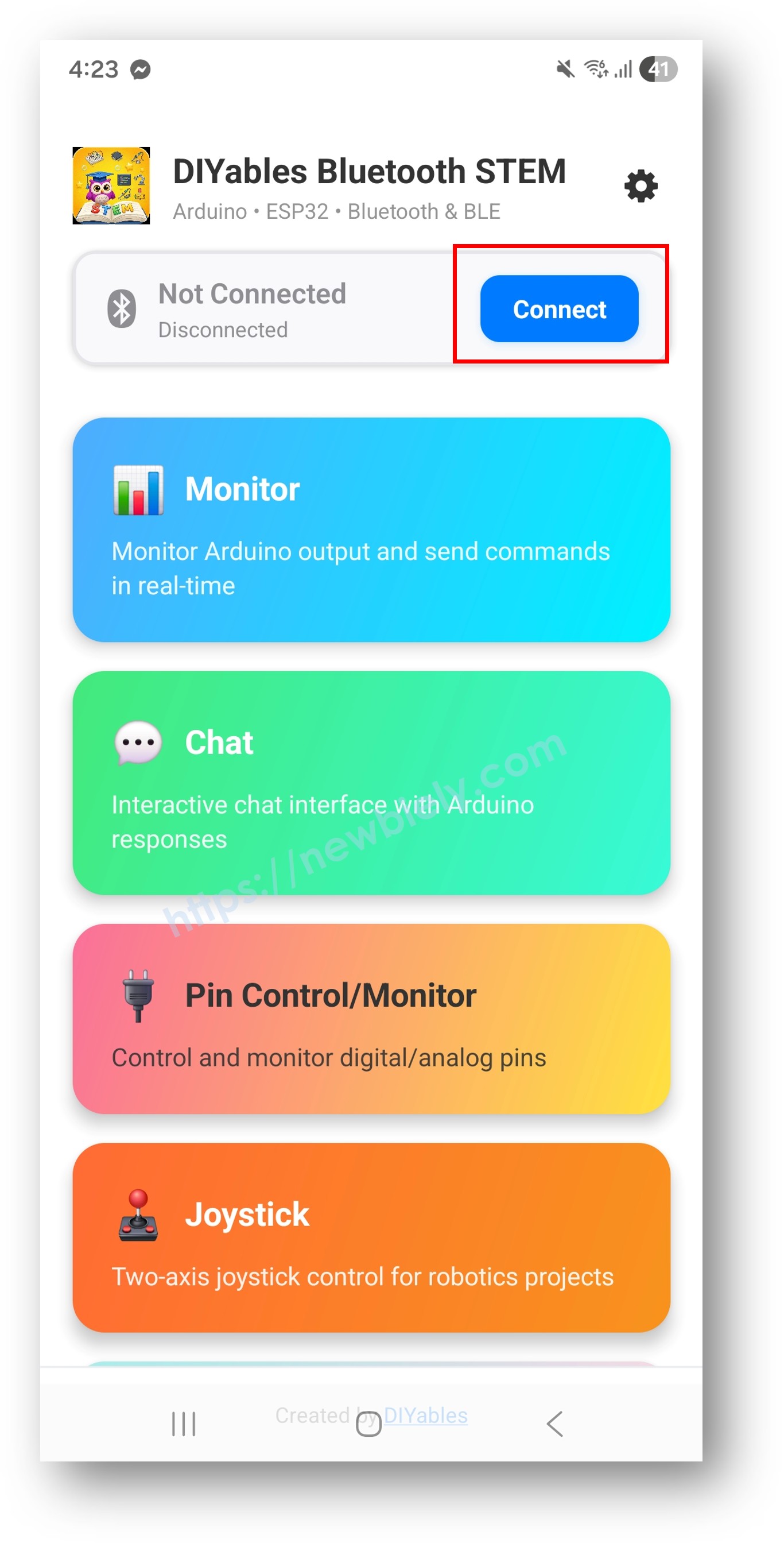
- 검색 결과에서 기기를 찾아 탭하여 연결합니다:
- 클래식 블루투스의 경우: "ESP32_Monitor" 탭
- BLE의 경우: "ESP32BLE_Monitor" 탭
- 연결되면 앱이 자동으로 홈 화면으로 돌아갑니다. 앱 메뉴에서 Monitor 앱을 선택합니다.
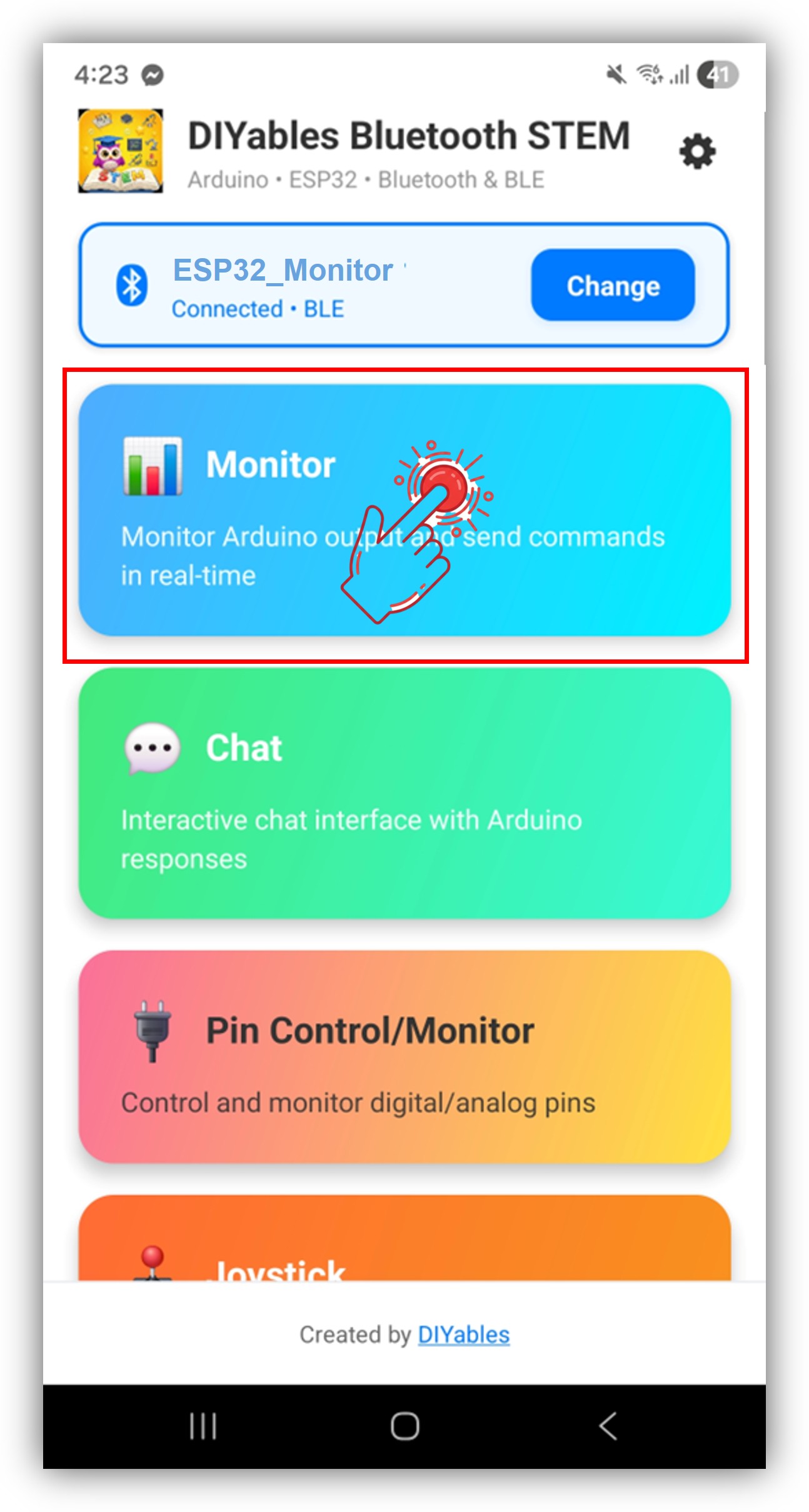
참고: 홈 화면에서 설정 아이콘을 탭하여 홈 화면에서 앱을 숨기거나 표시할 수 있습니다. 자세한 내용은 DIYables 블루투스 앱 사용 설명서를 참조하세요.
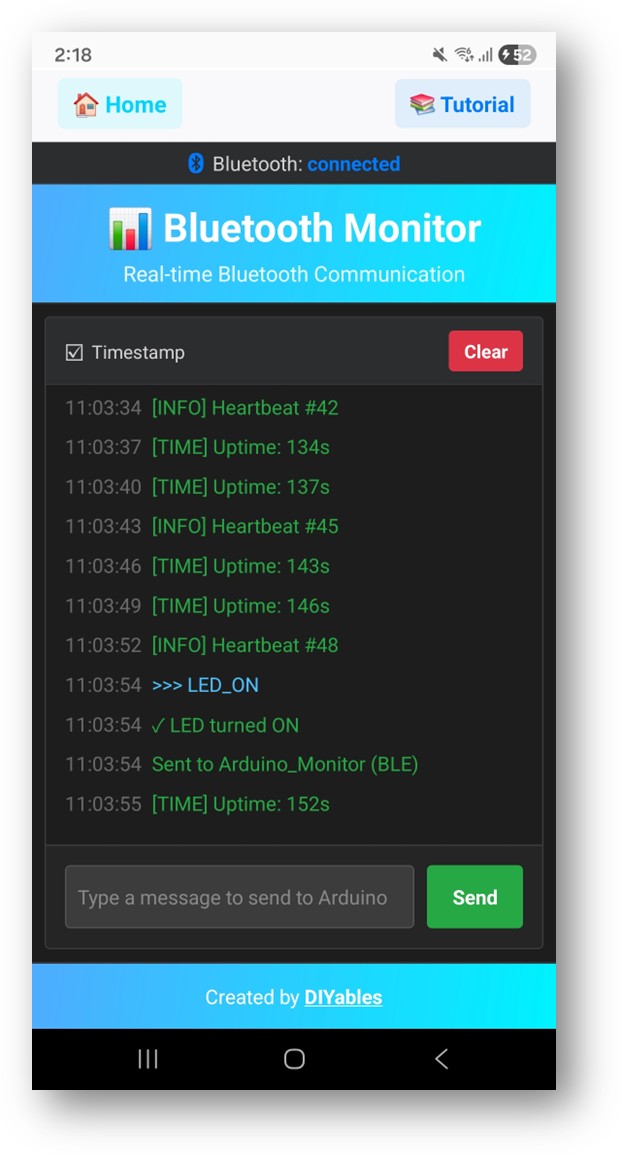
- 모니터 디스플레이에 상태 메시지가 스트리밍되는 것을 볼 수 있습니다.
- 입력 필드에 LED_ON을 입력하고 보내기를 탭하면 ESP32의 내장 LED가 켜지고 모니터에 확인 메시지가 표시됩니다.
Arduino IDE의 시리얼 모니터를 다시 보면 다음과 같이 표시됩니다:
8
Serial.println("Hello World!");
Message (Enter to send message to 'ESP32 Dev Module' on 'COM15')
New Line
9600 baud
Bluetooth connected!
Sent update #1
Sent update #2
Received command: HELP
Received command: STATUS
- 앱에서 명령을 입력하고(HELP, STATUS, LED_ON, LED_OFF, HEAP) 응답을 확인하세요.
창의적인 커스터마이징 - 프로젝트에 맞게 코드 조정하기
앱으로 메시지 전송
send() 메서드를 사용하여 모니터 디스플레이로 텍스트 메시지를 스트리밍합니다:
// Send simple messages
bluetoothMonitor.send("System initialized");
bluetoothMonitor.send("Sensor reading: 25.3°C");
// Send formatted data
bluetoothMonitor.send("[INFO] Heartbeat #" + String(count));
bluetoothMonitor.send("[WARN] Temperature high: " + String(temp) + "°C");
bluetoothMonitor.send("[ERROR] Sensor disconnected");
// Send system information
bluetoothMonitor.send("Free Heap: " + String(ESP.getFreeHeap()) + " bytes");
bluetoothMonitor.send("Uptime: " + String(millis() / 1000) + " seconds");
앱에서 명령 수신
bluetoothMonitor.onMonitorMessage([](String message) {
Serial.println("Received command: " + message);
if (message == "STATUS") {
bluetoothMonitor.send("ESP32 running OK");
}
});
연결 이벤트 처리
bluetoothServer.setOnConnected([]() {
Serial.println("Bluetooth connected!");
bluetoothMonitor.send("ESP32 connected!");
});
bluetoothServer.setOnDisconnected([]() {
Serial.println("Bluetooth disconnected!");
});
비디오 튜토리얼
아래 동영상 데모는 아래 코드를 사용합니다:
/*
* 이 ESP32 코드는 newbiely.kr 에서 개발되었습니다
* 이 ESP32 코드는 어떠한 제한 없이 공개 사용을 위해 제공됩니다.
* 상세한 지침 및 연결도에 대해서는 다음을 방문하세요:
* https://newbiely.kr/tutorials/esp32/esp32-diyables-bluetooth-app-monitor
*/
/*
* DIYables Bluetooth Library - ESP32 Classic Bluetooth Monitor Example
* Works with DIYables Bluetooth STEM app on Android
* Note: Classic Bluetooth is NOT supported on iOS. Use BLE examples for iOS support.
*
* This example demonstrates the Bluetooth Monitor feature:
* - Send real-time status messages to the mobile app
* - Display system information and sensor readings
* - Receive and process commands from the app
* - Perfect for debugging and system monitoring
*
* Compatible Boards:
* - ESP32 (all variants with Classic Bluetooth)
* - ESP32-WROOM-32
* - ESP32-DevKitC
* - ESP32-WROVER
*
* Note: Select "Huge APP (3MB No OTA/1MB SPIFFS)" partition scheme
* in Arduino IDE: Tools > Partition Scheme
*
* Setup:
* 1. Upload the sketch to your ESP32
* 2. Open Serial Monitor (115200 baud) to see connection status
* 3. Use DIYables Bluetooth App to connect and view monitor output
*
* Tutorial: https://diyables.io/bluetooth-app
* Author: DIYables
*/
#include <DIYables_BluetoothServer.h>
#include <DIYables_BluetoothMonitor.h>
#include <platforms/DIYables_Esp32Bluetooth.h>
// Create Bluetooth instances
DIYables_Esp32Bluetooth bluetooth("ESP32_Monitor");
DIYables_BluetoothServer bluetoothServer(bluetooth);
// Create Monitor app instance
DIYables_BluetoothMonitor bluetoothMonitor;
// Variables for demo
unsigned long lastUpdate = 0;
const unsigned long UPDATE_INTERVAL = 3000; // Send update every 3 seconds
int messageCount = 0;
bool ledState = false;
// ESP32 built-in LED (may vary by board)
const int LED_PIN = 2;
void setup() {
Serial.begin(115200);
delay(1000);
Serial.println("DIYables Bluetooth - ESP32 Monitor Example");
// Initialize LED
pinMode(LED_PIN, OUTPUT);
digitalWrite(LED_PIN, LOW);
// Initialize Bluetooth server with platform-specific implementation
bluetoothServer.begin();
// Add monitor app to server
bluetoothServer.addApp(&bluetoothMonitor);
// Set up connection event callbacks
bluetoothServer.setOnConnected([]() {
Serial.println("Bluetooth connected!");
bluetoothMonitor.send("=== ESP32 Monitor Connected ===");
bluetoothMonitor.send("System Ready");
bluetoothMonitor.send("Type HELP for available commands");
bluetoothMonitor.send("");
});
bluetoothServer.setOnDisconnected([]() {
Serial.println("Bluetooth disconnected!");
});
// Set up message handler for incoming commands
bluetoothMonitor.onMonitorMessage([](const String& message) {
Serial.print("Received command: ");
Serial.println(message);
handleCommand(message);
});
Serial.println("Waiting for Bluetooth connection...");
}
void handleCommand(const String& cmd) {
if (cmd == "HELP") {
bluetoothMonitor.send("Available Commands:");
bluetoothMonitor.send(" LED_ON - Turn LED on");
bluetoothMonitor.send(" LED_OFF - Turn LED off");
bluetoothMonitor.send(" STATUS - Show system status");
bluetoothMonitor.send(" HEAP - Show memory info");
bluetoothMonitor.send(" CLEAR - Clear monitor (if supported)");
bluetoothMonitor.send(" HELP - Show this help");
}
else if (cmd == "LED_ON") {
digitalWrite(LED_PIN, HIGH);
ledState = true;
bluetoothMonitor.send("✓ LED turned ON");
}
else if (cmd == "LED_OFF") {
digitalWrite(LED_PIN, LOW);
ledState = false;
bluetoothMonitor.send("✓ LED turned OFF");
}
else if (cmd == "STATUS") {
showStatus();
}
else if (cmd == "HEAP") {
bluetoothMonitor.send("=== Memory Info ===");
bluetoothMonitor.send("Free Heap: " + String(ESP.getFreeHeap()) + " bytes");
bluetoothMonitor.send("Min Free Heap: " + String(ESP.getMinFreeHeap()) + " bytes");
bluetoothMonitor.send("Heap Size: " + String(ESP.getHeapSize()) + " bytes");
bluetoothMonitor.send("===================");
}
else if (cmd == "CLEAR") {
bluetoothMonitor.send("");
}
else {
bluetoothMonitor.send("✗ Unknown command: " + cmd);
bluetoothMonitor.send("Type HELP for available commands");
}
}
void showStatus() {
bluetoothMonitor.send("=== System Status ===");
// LED Status
bluetoothMonitor.send("LED State: " + String(ledState ? "ON" : "OFF"));
// Uptime
unsigned long uptime = millis() / 1000;
bluetoothMonitor.send("Uptime: " + String(uptime / 3600) + "h " + String((uptime % 3600) / 60) + "m " + String(uptime % 60) + "s");
// ESP32-specific info
bluetoothMonitor.send("Free Heap: " + String(ESP.getFreeHeap()) + " bytes");
bluetoothMonitor.send("CPU Freq: " + String(ESP.getCpuFreqMHz()) + " MHz");
bluetoothMonitor.send("Chip Model: " + String(ESP.getChipModel()));
// Messages sent
bluetoothMonitor.send("Messages Sent: " + String(messageCount));
bluetoothMonitor.send("====================");
}
void sendPeriodicUpdate() {
messageCount++;
// Example of different message types
if (messageCount % 3 == 0) {
bluetoothMonitor.send("[INFO] Heartbeat #" + String(messageCount));
}
else if (messageCount % 5 == 0) {
bluetoothMonitor.send("[HEAP] Free: " + String(ESP.getFreeHeap()) + " bytes");
}
else {
bluetoothMonitor.send("[TIME] Uptime: " + String(millis() / 1000) + "s");
}
Serial.print("Sent update #");
Serial.println(messageCount);
}
void loop() {
// Handle Bluetooth server communications
bluetoothServer.loop();
// Send periodic updates (only when connected)
if (bluetooth.isConnected() && millis() - lastUpdate >= UPDATE_INTERVAL) {
lastUpdate = millis();
sendPeriodicUpdate();
}
delay(10);
}


